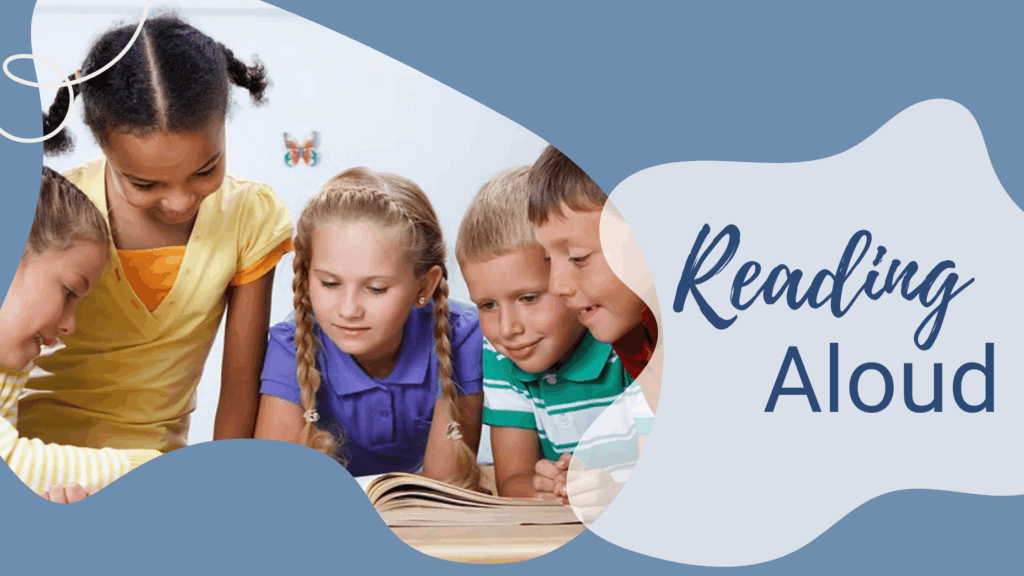
Most people would agree that being able to read aloud well is an important skill to have. It is so much easier to listen to a fluent reader than to listen to a halting hesitant trial and error approach. A well-read passage means the content is clear and meaningful but a fluent and also expressive reading is even better.
So what can you do to help your child become a confident, entertaining reader? It is obviously important that a young reader first knows how to recognize basic sight words and how to decode other words phonetically but they also need to be able to easily identify frequently used words. Thankfully, there are several methods for teaching a child to read but it is often assumed that once a child has a significant number of words they can recognize or read correctly that they will, with some practice, become a fluent reader, and hopefully, one that reads with meaning and understanding. Sadly, this is often not the case.
Reading with meaning – Phrasing and Pausing
So what steps should you take to set your child on a path to becoming an effective and expressive reader? Well, focus first on fluency, which is, reading smoothly, by teaching your reader to read in phrases, pausing between ideas. Initially, this means reading short phrases or short sentences and then pausing slightly before beginning the next phrase or sentence. Try this one and pause at the slash marks .
The young colt pranced around the field, \ kicking and tossing his head | while his dark brown mother neighed \ and watched proudly.
If your child is struggling with this phrasing you could make the phrases shorter and the pauses more frequent like this,
The young colt \ pranced around the field, \ kicking \ and tossing his head | while his dark brown mother neighed \ and watched proudly.
It is often helpful to mark the pauses with a slash line “/” as a reminder of where to pause. Now this technique might seem to create a choppy reading at first, but it will pay off later when your reader shares more advanced passages with longer and more complicated sentences. With practice your child will learn to shorten or lengthen their pauses to suit the material they are reading aloud. For now, encourage your reader to speak more slowly and with slightly longer pauses as they practice the pausing and phrasing technique.
Besides pausing between phrases, readers should eventually learn to pause between paragraphs, between different speakers, or changes of topic or scene. This will make the meaning clearer. It says to the listeners that “there is a change here. Something different is happening.”
Reading with expression – Coloring words
Along with reading more fluently, reading expressively adds meaning and interest. Most readers can usually identify sound and action words like POW! CRASH! ROAR! easily and know how to read them expressively, especially if they are in a different font, or larger and bolder than the rest of the text. Children can be taught to emphasize other sound and action words too, even if they are printed in the same size font.
The dragon roared and blew flames that blistered and burned the surrounding trees. The tall timbers shivered and shook and crashed to the ground!
The words, roared, blew, blistered, burned, shivered, shook, and crashed can all be said in a way that suggests their meaning. This is called colouring words and is done by stressing the vowel sound and thinking of the meaning of the word.
Encourage your reader to examine the passage before reading it aloud to find words that express sound and action. (These words could be circled so they are easy to identify and colour when they are reading aloud.)
Reading with meaning – Stressing keywords
Once they are accustomed to reading in phrases, with pauses between and adding expression to sound and action words, children can learn to stress or emphasize the most important words in the content to make the meaning clearer.
Try underlining one word in a sentence and emphasizing that word as the sentence is read aloud. Erase the marking and underline another word and reread the sentence. Erase, underline yet another word and read aloud again. You will see that the meaning often changes a great deal.
The sentences below have been typed in bold to give examples. Read these and then try the exercise on the sentences that follow.
I told him to put the blue box under the large, brown desk.
(meaning, the blue box, not the red or yellow or green one)
I told him to put the blue box under the large brown desk.
(meaning under not on top of or beside)
I told him to put the blue box under the large, brown desk.
(meaning the desk, not the table or chair or box)
Reading with meaning and adding expression
Readers can also add changes of tone, or feeling to match the mood of a speaker or a scene. They can also change the pace to suit the scene, for example, a faster speed for an exciting event or a slower pace for a quiet, sad, or mysterious situation.
Do you remember the last time you were listening to a reader and you were able to understand difficult content easily as it was read with meaning, emphasis and clarity?
Imagine listening to a story read dramatically with special voices for different characters, exciting builds to a climax, different moods and atmospheres created effectively with a variety of pace and tone. Now think about the last news report you heard that was so effectively read that you could imagine the scenario vividly.
Your child can learn to read effectively and expressively just like audiobook narrators and national news reporters and you can help them learn these skills.