
Simple ways to teach toddlers and preschoolers to add helpful details
Do you ever find yourself puzzled as your young child tries to explain what has just happened?
There may be a great deal of excitement or plenty of tears, but no clear explanation.
Imagine this scene:
“Noooooooo! It broke! It broke!”
“What happened?”
“It broke!”
“What broke?”
“He did it!”
“Who did?”
“It broke! It broke!”
The conversation continues, with lots of hugs and cuddles, but no direct answer to the questions: What broke? Who broke it?
You want to help, but first you need more information.
This is often the problem: a lack of details.
It is also a communication problem we can continue to experience as we get older. Other people may not understand us because we haven’t provided enough information to make our message clear.
In the previous blog, How to Help Children Support Their Ideas and Opinions, we looked at the importance of using details, facts, examples and reasons to support a message.
But can children as young as three and four begin learning this skill?
They can! The word support may be too abstract for toddlers and preschoolers, but they can learn to describe things more fully and add helpful details to what they say.
What Kind of Support Can Young Children Learn?
At this age, children can begin learning to describe:
- Colour
- Size
- Shape
- Movement
- Sound
- Texture
- Actions
These descriptive words give children more ways to express themselves.
Instead of asking for “the truck,” a child might learn to ask for “the long red truck.”
Rather than telling you “the dog did something,” they may eventually be able to explain that “the big dog jumped over the fence.”
This descriptive vocabulary helps children provide the information other people need to understand them.
Fortunately, you don’t need to create formal lessons to introduce these skills. You can build them into your child’s normal play and everyday routines.
Practise Describing Toys and Everyday Objects
When playing with toys, ask your child to find a specific object.
For example:
“Let’s put your long red truck on the wooden bridge.”
When getting dressed, you might say:
“Can you find the green T-shirt with long sleeves?”
At snack time, you could ask:
“Would you like the small red apple or the big green one?”
By including two or three details in your request, you are helping your child hear how descriptive words make a message clearer.
Once your child becomes comfortable with the activity, reverse the roles. Ask your child to describe the object they want you to find.
If they say, “Get the truck,” you could ask:
- What colour is it?
- Is it big or small?
- Where is it?
- What does it do?
Encourage your child to provide enough information for you to identify the correct object.
Make this playful. Choose the wrong truck occasionally and let your child correct you by adding more details!
Build Descriptive Language While Reading
Books and pictures provide many opportunities to practise descriptive language.
While looking at a book together, ask your child to find:
- Something that can move quickly
- An animal that can make a loud, scary noise
- Something round and yellow
- An animal that can purr
- A person wearing a red hat
- Something that might feel soft
You can also take turns describing an object or character without naming it.
You might say:
“I can see something small and furry with a long tail. It can climb trees. What am I looking at?”
Then let your child describe something for you to find.
Activities like these help children notice important features, select useful words and organize those details into a message someone else can understand.
Ask Questions That Help Your Child Add Details
Another way to help young children expand their explanations is to ask simple questions.
Returning to the broken-object example, you might ask:
- What broke?
- Who broke it?
- Can you show me?
- Where did it happen?
- What happened first?
- How did it break?
You are collecting the information you need by asking for specific details. At the same time, you are showing your child what information was missing from the original explanation.
Try to ask one question at a time and give your child a chance to respond. Too many questions in a row can feel overwhelming, particularly when a child is already excited or upset.
If your child cannot find the words, offer simple choices:
“Did the red truck break, or was it the blue car?”
“Did it fall off the table, or did someone step on it?”
Once your child is calm, you can help put the details together:
“The blue car fell off the table, and one of its wheels broke. Is that what happened?”
This models a clear explanation while also checking that you have understood correctly.
Model More Detailed Responses
Young children learn a great deal by listening to how adults speak. You can model how to include useful details in ordinary conversations.
For example:
“Which gift should we give Jeremy for his birthday: the robot rabbit that wiggles its nose and hops, or the building set for making a pirate ship?”
Or:
“You need new shoes. What do you think of these blue ones with the green stripe and flashing lights?”
You are not giving a lesson or asking your child to repeat the description. You are simply showing how a few carefully chosen details make it easier to picture and identify something.
You can model this while cooking, getting dressed, walking outside, tidying toys or discussing what you see through the car window.
Keep Descriptions Short and Clear
Teaching children to add details does not need to become like a formal speaking lesson.
Use short questions and descriptive language while you:
- Play with toys
- Read picture books
- Get dressed
- Prepare meals
- Go for walks
- Sort laundry
- Look for items in a store
- Talk about something that happened
These small conversations help children gradually develop the vocabulary and confidence they need to express themselves more clearly.
As children get older, they will be able to understand more information and provide more support in their own explanations, ideas and opinions.
In an upcoming blog, we’ll look at ways to build these skills with children between the ages of five and seven.
For now, try adding two or three descriptive details to one of your daily activities. Then invite your child to do the same. You may be surprised by how quickly their explanations become easier to understand!
More Help Developing Your Child’s Speaking Skills
Read How to Include Oral Communication Skills in Your Daily Homeschool Routine for more ways to build speaking practice into everyday learning.

You can also explore Sharing Opinions: From Thoughts to Words, an interactive resource designed to help children express their opinions with greater clarity and confidence.
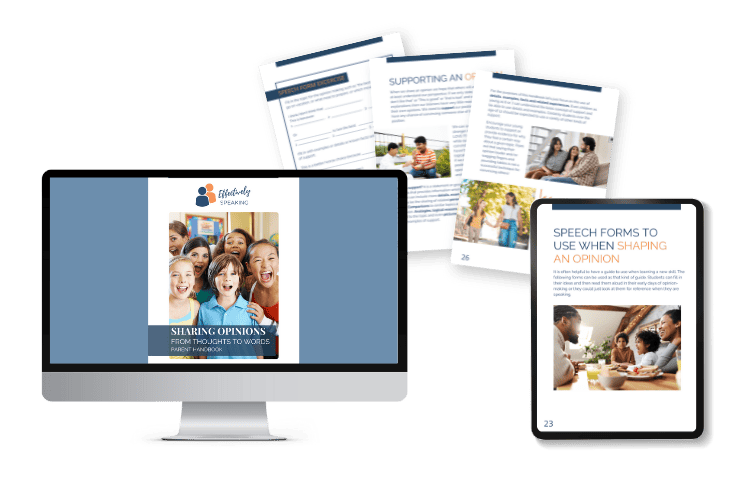
Sharing Opinions: From Thoughts to Words
This essential guide equips children with the skills to express their opinions with clarity and conviction. Packed with interactive activities, practical tips, and inclusive strategies, it encourages family-wide engagement in building stronger, more meaningful conversations and decisions.