Are you concerned that your child may have a speech delay or be falling behind in their communication development? What should you do? Is there anything you can do to help?
First of all, try not to panic. There may be no serious concerns with your child’s development. Even if there are some delays, there are many things you can do to support your child’s progress.
This blog contains helpful information, practical suggestions, and simple activities you can begin using right away.
Quick Summary
- Speak with your family doctor about your concerns
- Consider consulting a speech therapist or speech-language pathologist
- Create a language-rich environment at home
- Read, talk, and play with your child every day
- Practice listening, storytelling, and articulation activities
- Be patient and consistent in your efforts
Start by Understanding the Cause
If you read our previous blog, “Should You Be Worried if Your Child Has a Speech Delay?“, you will know that there can be a variety of reasons for an apparent speech delay. These may include hearing issues, developmental delays, or environmental influences.
It can be helpful to do some research and seek out local resources. Consult your family doctor and inquire about speech therapists or speech-language pathologists who may be able to assess your child’s needs.
Sometimes an appointment for testing or evaluation may be recommended, and there can occasionally be a waitlist. Other times, testing may not be necessary, but you may still want to support your child’s communication development.
Whatever the situation, there are many things you can begin doing at home right away.
How Can I Help My Child with a Speech Delay?
- Talking with them throughout the day
- Reading books together regularly
- Encouraging storytelling and imaginative play
- Practicing listening and following directions
- Playing language-based games
- Supporting articulation through fun speech activities
- Seeking professional guidance when needed
Create a Language-Rich Environment at Home
While waiting for an appointment or simply exploring ways to help, you can begin creating an environment that encourages communication and language development.
Not only will you be helping your child improve their communication skills, but you will also be:
- Building your relationship and strengthening your bond
- Playing an active role in your child's growth and learning
- Developing related skills such as vocabulary, comprehension, imagination, and confidence
Build Communication Skills Through Everyday Conversations
Many communication skills can be developed through simple everyday conversations.
Talk to your child about what you are doing and why you are doing it. Explain household tasks such as loading the dishwasher, preparing meals, folding laundry, or gardening.
Take time to chat with your child during play activities. Talk about the toys they are using or the activities they are enjoying. Introduce new words naturally during your conversations.
For example:
“Which truck do you like best? The tiny one or the huge one?”
“Can you pass me the shiny red and yellow caboose?”
The more language a child hears, the more likely they are to understand it and eventually use it in their own conversations.
Read Together Every Day
Reading is one of the most powerful ways to support speech and language development.
Read familiar books as often as your child requests them, but also introduce new stories. Talk about what is happening in the story, the choices characters make, and the challenges they face.
You can even act out scenes from the story together and take turns playing different characters.
Want more simple, parent-friendly ways to support strong communication skills?
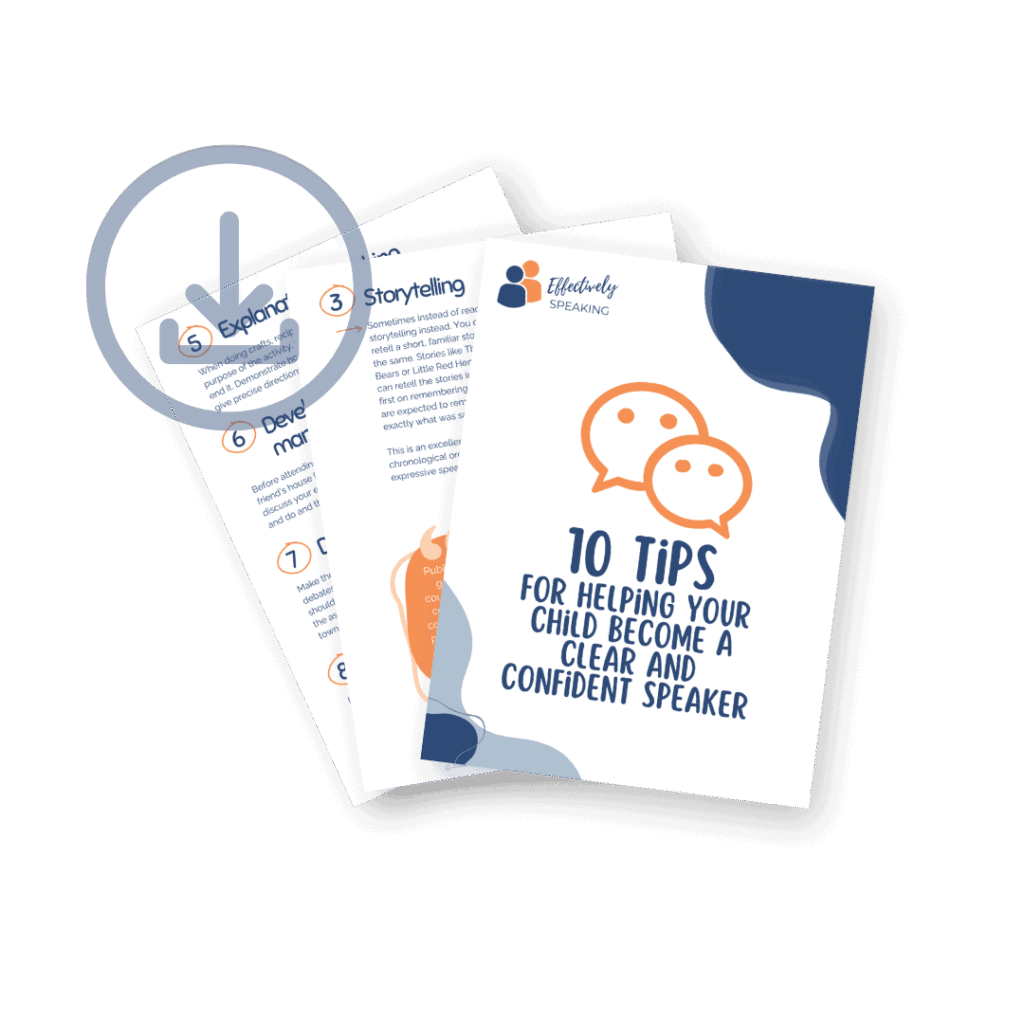
For additional practical strategies, download our free resource: 10 Tips to Help Your Child Become a Confident Speaker.
(It’s filled with everyday strategies you can start using right away.)
Encourage Storytelling and Imagination
Storytelling is another enjoyable and valuable activity.
You might retell familiar stories but leave out key details and invite your child to fill in the missing parts. Alternatively, you could change a familiar story and create a new version together.
For example, instead of asking her farm friends to help make bread, Little Red Hen could ask them to help make pizza or chocolate chip cookies.
These activities are fun, but they also help children develop:
- Comprehension skills
- Vocabulary
- Sequencing abilities
- Creative thinking
- Understanding of story structure
Strengthen Listening Skills Through Play
Listening is an essential part of communication.
Play games that encourage your child to listen carefully and follow directions.
For example:
“I will cover my eyes while you hide your teddy bear somewhere in this room. Tell me when you are ready and I will try to find him.”
“Please help me set the table. You will need to get forks, knives, and spoons.”
“Go and get your shoes and your blue jacket and bring them here. We will soon be going for a walk.”
You can also play games such as Simon Says:
- Walk on tiptoe.
- Stomp like a dinosaur.
- Fly like an eagle.
These activities strengthen listening skills while also building vocabulary and comprehension.
Involve your child in cooking, crafts, simple science experiments, and everyday household activities. Talk about what you are doing and why.
These experiences encourage both language development and natural conversation.
Develop Speech Clarity and Articulation
The activities discussed so far help build language and communication skills. However, sometimes it is the clarity of speech sounds that needs additional attention.
Speech therapists and speech-language pathologists can provide professional support, but there are also activities you can practice at home.
Speech sounds are formed using the tongue, lips, teeth, and other speech muscles. Strengthening these muscles can help children produce clearer speech sounds.
The good news is that this practice can be fun!
Make Silly Faces
Encourage your child to make funny faces and join in yourself.
Try:
- Fish faces
- Frog tongues catching flies
- Lip popping sounds
- Big tiger smiles
- Saying "Oh," "Ooo," and "Ow" dramatically
Use Straws
Straws can help strengthen the lips and improve oral motor control.
Try activities such as:
- Blowing cotton balls across a table
- Sucking up lightweight materials
- Racing objects from one side of the table to the other
If your child struggles with specific speech sounds, our TH Sound Articulation Guide provides additional exercises and practice activities.
Helpful Do's and Don'ts for Parents
Do:
- Use simple, clear language
- Speak at a slower pace
- Introduce new vocabulary naturally
- Make eye contact when speaking
- Get down to your child's level
- Model clear speech and pronunciation
- Allow your child time to respond
- Encourage conversation during everyday activities
Don't:
- Overwhelm your child with long explanations
- Rush conversations
- Keep background television on constantly
- Dominate playtime or conversations
- Show frustration when communication is difficult
Final Thoughts
There are many ways parents can support speech and language development at home. You do not need to try every suggestion at once. Choose one or two activities that fit naturally into your daily routine and build from there.
Consistency is often more important than perfection. Small moments of conversation during meals, car rides, story time, and play can add up to meaningful progress over time.
Most importantly, keep communication positive and enjoyable. Celebrate your child’s efforts, be patient with the process, and remember that every child develops at their own pace. With encouragement, practice, and the right support when needed, communication skills can continue to grow.
Looking for More Communication Resources?
Explore the resources available at Effectively Speaking for parents, caregivers, and educators who want to help children become stronger, more confident communicators.
Frequently Asked Questions About Speech Delay
What are the signs of a speech delay in children?
Some common signs of a speech delay include a limited vocabulary for their age, difficulty combining words into sentences, trouble pronouncing sounds, difficulty following directions, or frustration when trying to communicate. Every child develops at their own pace, but if you have concerns, it is worth discussing them with your family doctor or a speech-language pathologist.
Can I help my child with a speech delay at home?
Yes. Parents can support speech development through regular conversations, reading together, storytelling, listening activities, games, and opportunities for social interaction. Consistent practice during everyday activities can make a meaningful difference.
Should I be worried if my child is not talking as much as other children?
Children develop communication skills at different rates. Some children simply need more time, while others may benefit from additional support. If you are concerned about your child’s speech or language development, consult your family doctor or a speech-language pathologist for guidance.
What activities help improve speech and language skills?
Reading aloud, storytelling, imaginative play, singing songs, playing listening games, following directions, and engaging in daily conversations are all excellent ways to build speech and language skills.
When should I seek professional help for a speech delay?
If your child is not meeting communication milestones, seems unable to understand simple directions, has difficulty being understood by others, or if you have ongoing concerns, it is a good idea to seek professional advice. Early support can often be very beneficial.
Does reading help children with speech delays?
Yes. Reading exposes children to new vocabulary, sentence structures, ideas, and conversations. It also creates opportunities for discussion, questions, and language development in a positive and enjoyable way.
Can speech delays improve over time?
Many children make significant progress with consistent support, practice, and, when necessary, professional intervention. Every child is unique, but patience, encouragement, and regular communication opportunities can help children develop stronger speech and language skills.